Calling every smart app AI is like calling every vehicle a car. The word is correct, yet it hides a lot of useful detail. When people compare AI vs machine learning vs deep learning, they are really asking how three ideas relate. This guide sorts them out with plain language, and a good starting point is how AI works in everyday life.
Many articles treat the three terms as the same thing. In fact, they are nested, like a set of boxes. Once you see the layout, news stories and product pages become much easier to read. Let us begin with the big picture.
The Big Picture: How the Three Fit Together
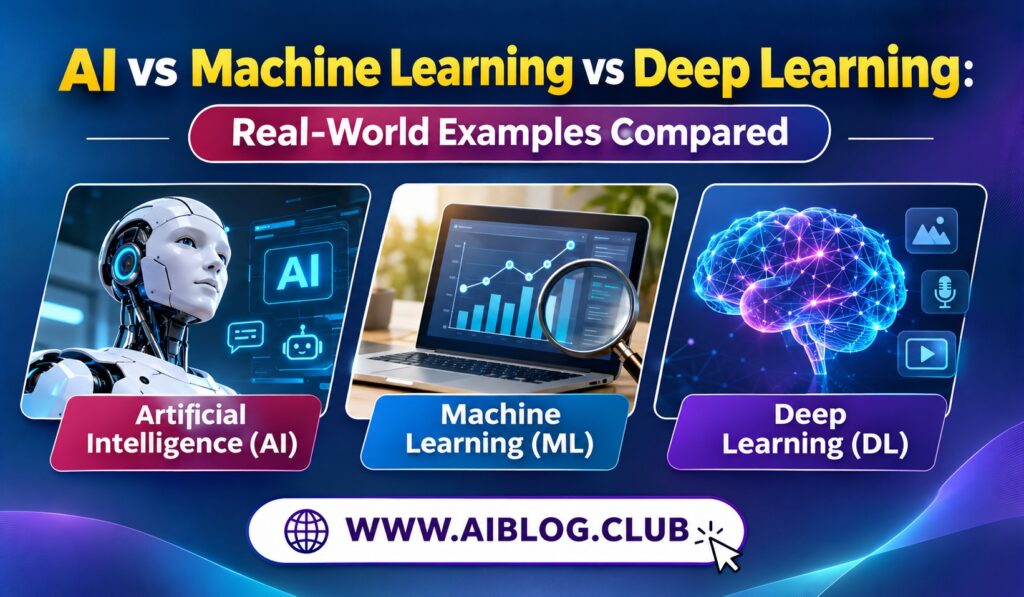
Picture three circles, one inside the other. The largest circle is artificial intelligence. Inside it sits machine learning, and inside that sits deep learning. Every deep learning system counts as machine learning, and every machine learning system counts as AI. However, the reverse is not true.
This nesting explains most of the confusion. A tool can be AI without using any learning at all. For example, a simple program that follows hand-written rules can still be called AI. Meanwhile, a deep learning model is a very specific tool within the wider family. Teachers often draw this as overlapping circles, which makes the order easy to remember. Keep that picture in mind as you read the sections below.
What Is Artificial Intelligence
Artificial intelligence is the broad goal of making machines perform tasks that normally need human thinking. The name came from a 1956 workshop at Dartmouth College. Since then, the field has used many different methods to reach that goal.
Early AI relied on rules. Programmers wrote instructions such as “if this happens, then do that,” and the computer followed them. In 1997, IBM’s Deep Blue beat chess champion Garry Kasparov using powerful search and carefully built chess knowledge. That success was impressive, but the machine could not learn any new game by itself. So, AI is the umbrella, and rules were only one early branch under it.
What Is Machine Learning
Machine learning is a branch of AI where computers learn patterns from data instead of following hand-written rules. Arthur Samuel, who worked on a checkers program, used the phrase in 1959. His idea was simple: let the machine improve through experience. Today, that idea drives much of modern technology.
There are three common styles of learning:
- Supervised learning uses labeled examples, such as emails marked spam or not spam.
- Unsupervised learning looks for hidden groups in data that has no labels.
- Reinforcement learning rewards good actions and penalizes poor ones, much like training a pet.
Classic machine learning often works well on tidy, table-style data. Think of rows of customer records with columns such as age, purchases, and location. In such cases, a person usually picks which details matter. Because of this, the approach is easier to explain and needs less computing power than deep learning.
What Is Deep Learning
Deep learning is a type of machine learning built on neural networks with many layers. The word “deep” refers to the number of layers, not to deep thinking. Each layer learns a slightly more complex feature than the one before it. For instance, early layers in an image model spot edges, while later layers spot shapes and faces.
The big turning point came around 2012. A deep learning model named AlexNet won a major image recognition contest by a wide gap. After that, the method spread to speech, translation, and text. If you want to see the inner workings, a clear explanation of how neural networks learn from data is a good next step.
On the other hand, deep learning is hungry. It usually needs large amounts of data and strong hardware. It also acts like a black box, so even experts struggle to explain why a model gave a certain answer. That trade-off matters when a decision affects someone’s health or money.
AI vs Machine Learning vs Deep Learning at a Glance
The table below puts the three side by side. Use it as a quick reference when a headline blurs the terms.
| Feature | AI | Machine Learning | Deep Learning |
| Scope | Broadest field | Subset of AI | Subset of machine learning |
| How it works | Rules or learning | Learns from data | Learns with many-layer networks |
| Data needed | Varies widely | Moderate | Very large |
| Human input | Writes rules | Picks key features | Finds features on its own |
| Example | Rule-based chess engine | Spam filter | Face recognition |
Real-World Examples You Already Use
Examples make the differences easier to remember. Start with plain AI that uses rules. A basic customer service menu that says “press 1 for billing” follows a fixed script. It looks smart, yet it does not learn anything from your call.
Now consider machine learning. Your bank may use it to spot unusual card spending by comparing each purchase with past patterns. Streaming services use it to suggest shows, and online stores use it to predict what you might buy next. In each case, the system learns from many earlier examples.
Deep learning shows up where the data is messy and rich. Phone cameras use it to recognize faces and improve photos. Voice assistants use it to turn speech into text. Translation apps use it to convert one language into another. Likewise, modern chatbots use a deep learning design called the transformer, which arrived in 2017.
Here is a quick way to sort what you see:
- If a tool follows fixed steps, it is plain AI.
- If it improves from past data, it is machine learning.
- If it handles images, sound, or free text through layered networks, it is deep learning.
Which Approach Fits Which Problem
Choosing between the three is rarely about which one is smartest. Instead, it is about the problem, the data, and the budget. A small business with a few thousand customer records will often do better with simple machine learning. It runs fast, costs little, and is easier to explain to a manager.
In contrast, a team working with photos, audio, or long text will likely need deep learning. These data types are hard to describe with a short list of features. Even so, the team needs plenty of examples and strong computers. Without those, a simpler method may actually perform better.
Rules still have a place as well. When a decision must be clear and predictable, such as a tax calculation, fixed rules are often the safest choice. As a result, many real products mix all three. A single app might use rules for safety checks, machine learning for predictions, and deep learning for reading images.
Finally, keep the bigger question in mind. All of these tools are narrow, meaning each one does a limited job. The idea of a machine that matches human ability across every task, known as artificial general intelligence, has not been built.
Key Takeaways
- Relationship: deep learning sits inside machine learning, which sits inside AI.
- AI: the broad goal of machines doing tasks that need human thinking.
- Machine learning: systems that learn patterns from data instead of fixed rules.
- Deep learning: many-layer neural networks that excel at images, sound, and text.
- Best choice: match the method to the problem, the data, and the budget.
Frequently Asked Questions
What is the main difference between AI and machine learning?
AI is the broad goal of smart machines, while machine learning is one way of reaching it by learning from data.
Is deep learning better than machine learning?
Not always, since deep learning needs more data and computing power and suits complex data like images and speech.
Is ChatGPT AI, machine learning, or deep learning?
It is all three, because it is an AI tool built with machine learning using a deep learning design.
Do I need a lot of data for machine learning?
Classic machine learning can work with moderate amounts, but deep learning usually needs far more.
Can a program be AI without machine learning?
Yes, because rule-based programs can also count as AI even though they never learn.
Conclusion
AI vs machine learning vs deep learning is really a story of nested ideas. AI is the wide goal, machine learning is the learning method, and deep learning is the layered, data-hungry specialist. Once you see that pattern, product claims and news headlines become much clearer. Pick the simplest tool that solves your problem, and remember that every system in use today is still narrow in what it can do.