An AI tool can hand you a perfect-looking citation for a paper that does not exist. That is the biggest danger in any AI research workflow. The fix is not to avoid AI. The fix is to build a habit of checking every source before it reaches your work. This guide shows how to verify sources and avoid fake citations step by step. For a quick overview of tools that can support this process, see our list of free AI tools.
Why AI Invents Citations
Language models predict likely words. They do not look facts up the way a librarian does. When asked for a source, a model may produce a title, author, and journal that sound right but are not real. This problem is often called hallucination.
Plausible is not the same as true. Because the output looks polished, many people trust it. Search-connected tools reduce the problem by linking real pages. Even so, a link can point to a page that does not support the claim. Checking remains your job.
A Simple AI Research Workflow
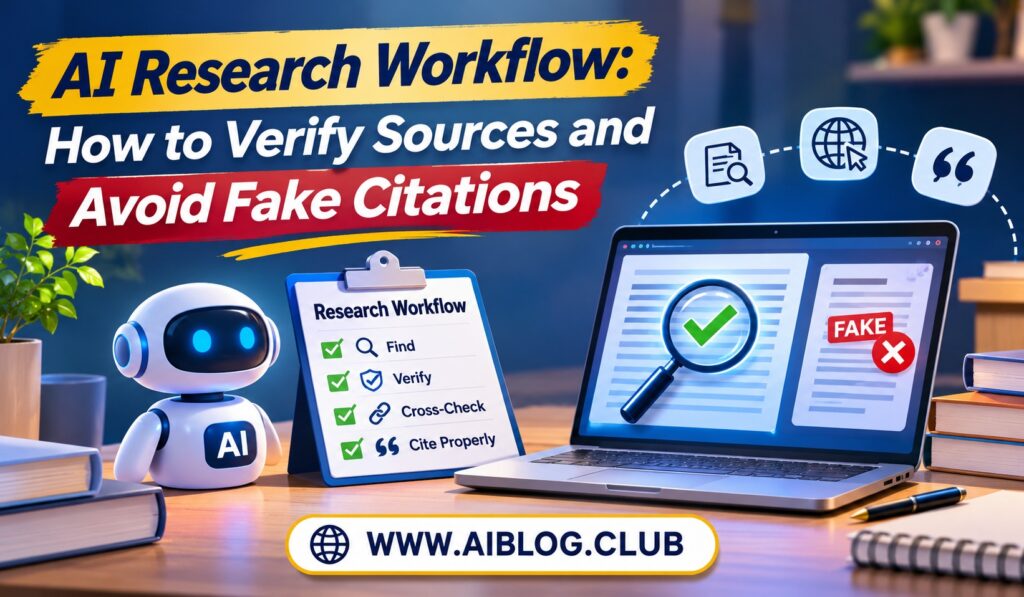
A clear routine keeps you safe and saves time. Use these steps every time.
Step 1: Define the Question
Write one clear research question first. A vague question invites vague answers. For example, ask “What does current evidence say about sleep and exam scores?” instead of “Tell me about sleep.”
Step 2: Use AI for Direction, Not Proof
Ask the AI for keywords, subtopics, and possible angles. Treat everything it says as a lead. A search-focused tool can also help, and our comparison of AI search engines shows which ones show sources clearly.
Step 3: Find the Original Source
Search for the paper, report, or page by its exact title. Use Google Scholar, a library database, or the publisher site. If you cannot find it in two places, treat it as unverified.
Step 4: Read the Part That Matters
Open the source and find the sentence behind the claim. Confirm the numbers, dates, and conclusions match. A real paper can still be quoted wrongly by an AI.
Step 5: Record and Cite Correctly
Copy the citation from the original page or from a trusted reference manager. Never copy a citation straight from a chatbot without checking it first.
Source Quality at a Glance
Not every real source deserves equal trust. Use this quick guide when you decide what to keep.
| Source Type | Trust Level | Check Before Using |
| Peer-reviewed journal | High | Publication date, study size |
| Government or official report | High | Release date, scope |
| Established news outlet | Medium | Original data source |
| Company blog | Medium | Bias, marketing goals |
| Anonymous forum post | Low | Almost everything |
Red Flags of Fake Citations
Some warning signs show up again and again. Watch for them.
- The title sounds too perfect for your exact question.
- The authors cannot be found anywhere else online.
- The journal name is real, but the article is missing from its archive.
- The link leads to a page that is unrelated or does not exist.
- The year, volume, or page numbers do not match the journal.
- The quote cannot be found in the source text.
If you see even one of these, stop and search again. Often a quick title search settles the matter in under a minute.
Tools That Help You Verify
Several free tools make checking easier. Google Scholar lets you search by exact title, and many libraries offer database access for students. A DOI lookup can confirm that a paper is registered. Reference managers help you store clean citations.
Tools such as NotebookLM and Elicit can also help you work with real papers and your own files. Even so, you must open the original papers yourself. Meanwhile, if you use a chatbot for summaries, try more than one. Our article on ChatGPT, Claude, and Gemini explains how to compare assistants on accuracy with your own test.
Keep a Research Log
A simple log protects you later. Create a table with columns for the claim, the source, the link, the date checked, and a verified mark. When your teacher or editor asks where a fact came from, you will know in seconds.
Also save the exact prompt you used, since it helps you repeat your steps. Over time, the log becomes a personal library of trusted sources. As a result, each new project starts faster and with more confidence.
A Worked Example
Suppose you are writing about sleep and exam scores. You ask an AI for sources, and it lists four studies. Instead of copying them, you search each exact title. Two appear in Google Scholar with matching authors and years. One title exists, but the authors are different. The fourth cannot be found anywhere.
Now you know what to do. Keep the first two, correct the third using the real record, and delete the fourth. Next, you open the two verified papers and read the abstract and results. In the end, you cite only what you have actually checked, which keeps your work honest.
Common Mistakes to Avoid
Even careful people slip. These mistakes show up often in student and blog work.
- Copying citations from a chatbot: Always rebuild them from the original page.
- Trusting a link without opening it: The page may not support the claim.
- Using old data without a date check: Statistics age quickly.
- Citing a summary instead of the study: Go to the original source.
- Skipping the verification step when rushed: Rushed work causes the biggest errors.
Citation Style Basics
Every school and publisher has its own style, such as APA, MLA, or Chicago. Check which one applies before you start. A reference manager can format citations for you, but you must still confirm that each detail matches the real source.
Include the author, title, publication, date, and a working link or DOI where possible. Add the date you accessed an online page if your style asks for it. Clean, consistent citations also make it easier for readers to trust your work.
Prompts That Reduce Errors
Good prompts will not remove mistakes, but they can lower them. Ask the AI to say when it is unsure instead of guessing. You can also ask it to list only sources it can link, and to separate facts from opinions. Then check every link yourself.
Another useful habit is to ask for the reasoning behind a claim. If the explanation sounds vague, treat the claim with caution. Meanwhile, avoid prompts that demand a fixed number of sources, since that pressure can push a model to invent the last few. Ask for as many real sources as exist.
When to Skip AI Altogether
Some tasks need extra care. Medical advice, legal questions, and money decisions deserve a qualified human and official sources. In these areas, a wrong answer can cause real harm. Use AI only to understand terms or prepare questions, and let a professional confirm the details.
The same caution applies to quotes. If you plan to quote a person, find the original recording, book, or article. A quote from a chatbot has no value until you have found it in the real source. Taking this extra step protects both you and your readers.
Building the Habit
Habits beat tools. Start small by verifying just three sources in your next project. Once that feels easy, make checking part of every task. Before long, you will spot weak claims almost by instinct.
Share the routine with classmates or coworkers as well. A team that checks sources together catches more errors and builds shared trust in the final work.
Key Takeaways
- Biggest risk: AI can invent realistic but fake citations.
- Best habit: Always find the original source yourself.
- Best first check: Search the exact title in two places.
- Best use of AI: Direction and ideas, not proof.
- Best protection: A simple research log with a verified mark.
Frequently Asked Questions
Why do AI tools make up citations?
They predict likely text instead of looking up real records.
How can I check a citation quickly?
Search the exact title in Google Scholar or a library database.
Are linked sources always correct?
No, because a real link can still fail to support the claim.
Can I trust AI summaries of papers?
Use them as a starting point and confirm key points in the original paper.
Should I cite the AI tool?
Follow your school or publisher rules, and always cite the original source for facts.
Conclusion
A strong AI research workflow turns a risky tool into a helpful assistant. Use AI for ideas, find every original source, and read the key passage yourself. Verify sources, avoid fake citations, and keep a log so your work stays honest and easy to defend.